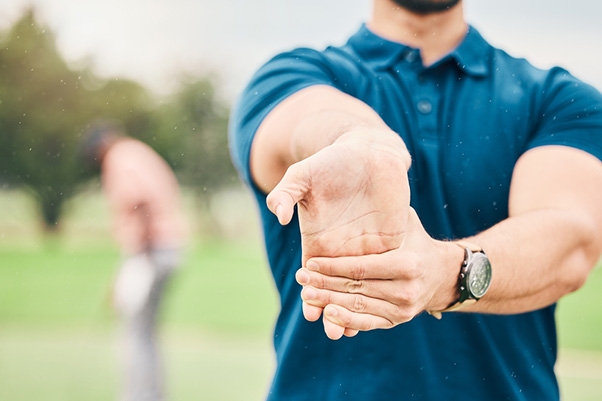
A golf swing looks effortless when executed well, but the wrists absorb substantial forces through the backswing, transition, impact, and follow-through. When wrist pain develops, golfers often assume they have simply overworked a tendon and try to play through it. That can be a mistake. Wrist pain may also involve ligaments, cartilage, bones, nerves, or arthritis. Here are some of the most common reasons golfers develop wrist pain and what the symptoms can mean.
Why Golf Puts So Much Stress on the Wrists
Golf requires repetitive gripping, rapid wrist movement, and forceful impact between the club and the ball. Repeating these movements over many rounds or practice sessions can place stress on the tendons, ligaments, and small bones that make up the wrist.
Sports-related wrist problems can result from repetitive use, excessive stress, or acute trauma. The practice also treats a broad range of wrist conditions, including tendonitis, ligament injuries, fractures, arthritis, and nerve-related problems.
For golfers, the distinction matters because different structures require different approaches to diagnosis and treatment.
Wrist Tendinitis Can Cause Pain With Gripping and Swinging
Tendinitis is certainly one possible explanation for wrist pain in golfers. Repetitive use can irritate the tendons responsible for moving the wrist and fingers, producing localized pain and tenderness.
Symptoms may become more noticeable when gripping a club, turning the wrist, or practicing repeatedly. Swelling and reduced motion can also occur.
Treatment often begins conservatively, with activity modification, ice, medication when appropriate, and physical therapy focused on restoring motion and strength. Repetitive use and trauma are often common contributors to wrist tendon irritation.
But persistent pain should not automatically be labeled tendinitis.
Ulnar-Sided Wrist Pain May Point to a Different Problem
Pain on the pinky side of the wrist deserves particular attention in golfers. This area contains several structures that can become irritated or injured through repetitive loading and rotation.
Several potential causes of ulnar-sided wrist pain include arthritis, fractures, nerve compression, repetitive-use injuries, triangular fibrocartilage complex injuries, and ulnar impaction syndrome.
A TFCC injury can be especially relevant when wrist pain develops with gripping or rotation. Depending on the injury, patients may also notice clicking, weakness, swelling, or difficulty moving the wrist normally.
Because several conditions can produce similar symptoms, pain location alone does not establish the diagnosis.
Could a Wrist Ligament Injury Be Causing Your Golf Pain?
Ligaments connect bones and help stabilize the wrist. Repetitive stress can contribute to ligament problems, while an acute event such as a fall can cause a more obvious sprain or tear.
A golfer may notice pain, swelling, bruising, weakness, reduced motion, or a popping sensation. Some ligament injuries can be relatively subtle at first, particularly when symptoms are attributed to overuse.
Wrist sprains involve stretching or tearing of wrist ligaments and may require imaging such as X-rays, CT scans, or MRI when a more significant injury is suspected.
Continuing to repeatedly load an unstable or injured wrist can make recovery more difficult.
A Fracture Can Sometimes Look Like an Overuse Injury
Not every golf-related wrist injury is caused by repetitive strain. Fractures can occur after falls or direct trauma, and some wrist fractures may initially resemble a less serious soft-tissue injury.
The scaphoid is one of the small bones of the wrist that can fracture after a fall onto an outstretched hand. Scaphoid fractures are listed among sports-related wrist injuries and imaging is important when a fracture is suspected.
Persistent pain after a fall, particularly when accompanied by swelling, tenderness, or restricted movement, should therefore be evaluated rather than assumed to be tendinitis.
Numbness and Tingling Suggest a Nerve Problem
Pain is not the only symptom golfers should watch for. Numbness, tingling, weakness, or difficulty gripping may indicate nerve involvement rather than a tendon problem.
Carpal tunnel syndrome, for example, occurs when the median nerve becomes compressed within the wrist. This can cause numbness or tingling involving the thumb, index finger, middle finger, and part of the ring finger, as well as weakness or pain that may extend into the forearm.
If wrist symptoms are accompanied by altered sensation or weakness, an orthopedic hand and wrist evaluation can help determine whether a nerve is involved.
When Should a Golfer See a Wrist Specialist?
Occasional soreness after an unusually long practice session may improve with appropriate rest. Persistent or worsening symptoms deserve more attention.
Consider an evaluation if you have:
- Wrist pain that continues despite reducing activity
- Swelling or bruising
- Weakness when gripping a club
- Clicking or popping
- Reduced wrist motion
- Numbness or tingling
- Pain after a fall or direct impact
- Pain that repeatedly returns when you resume golfing
Diagnosis typically begins with a medical history and physical examination. Depending on the suspected problem, X-rays, CT, MRI, or nerve studies may be used to better understand the underlying condition.
Treatment Depends on What Is Actually Causing the Pain
The right treatment for a golfer's wrist depends on the structure involved and the severity of the injury.
For some patients, treatment may include temporary activity modification, medication, ice, splinting, physical therapy, or targeted injections. More significant ligament injuries or fractures may require immobilization or surgery. Tendon or nerve problems may also require condition-specific treatment.
Both nonsurgical and surgical approaches are offered for hand and wrist conditions, including physical therapy, splinting, injections, fracture treatment, tendon repair, and other procedures when appropriate.
The goal is not simply to get a golfer back on the course as quickly as possible. It is to identify the source of the pain and restore the wrist's ability to tolerate the demands of the golf swing.
Frequently Asked Questions
Why does my wrist hurt when I play golf?
Golf-related wrist pain can result from tendon irritation, ligament injuries, cartilage problems, arthritis, fractures, nerve compression, or repetitive stress. The location and character of the pain can provide clues, but persistent symptoms require an evaluation to determine the specific cause.
Is wrist pain from golf always tendinitis?
No. Tendinitis is one possible cause, but golfers can also develop wrist sprains, ligament or TFCC injuries, fractures, arthritis, and nerve-related conditions.
Why does the pinky side of my wrist hurt when I golf?
Pain on the pinky side, or ulnar side, of the wrist can have several causes, including TFCC injury, ulnar impaction, arthritis, fractures, nerve problems, and repetitive-use injuries. Pain that occurs with gripping or twisting deserves evaluation if it persists.
Should I stop golfing if my wrist hurts?
If wrist pain is persistent, worsening, associated with swelling or weakness, or interfering with your grip or swing, reducing or stopping the activity until the cause is evaluated is generally appropriate. Continuing repetitive loading can aggravate some wrist injuries.
When should I see a hand and wrist specialist for golf-related wrist pain?
Seek evaluation when pain does not improve with reasonable rest, repeatedly returns when you resume golfing, follows an injury, or occurs with swelling, weakness, numbness, tingling, clicking, or restricted motion. A specialist can determine whether the problem involves a tendon, ligament, bone, cartilage, or nerve.
Wrist pain does not have to end your golf season, but it should not automatically be dismissed as tendinitis. Identifying the underlying problem is the first step toward choosing appropriate treatment and safely returning to the activities you enjoy. If persistent wrist pain is affecting your swing or everyday activities, a hand and wrist evaluation can help determine what is really causing it. The goal is to help you Move Better, Feel Better, and Be Better.
Reference Links:
- Mayo Clinic Q and A: Golf-related wrist pain and injuries - Mayo Clinic
- Sports-related wrist and hand injuries: a review - PubMed Central
AUTHOR: Dr. Mohammad Ali Khoshnevisan, MD, MBA - Hand & Wrist Surgeon
Mohammad Ali Khoshnevisan, MD is a hand and wrist surgeon specializing in the diagnosis and treatment of hand, wrist, and upper extremity conditions at Town Center Orthopaedics in Ashburn, Centreville, Fairfax, and Reston, Virginia. Dr. Khoshnevisan provides comprehensive care for a wide range of hand and wrist conditions, with an emphasis on helping patients understand their diagnosis and treatment options so they can make informed decisions about their care.
Credentials & Recognition
A native of Germantown, Maryland, Dr. Khoshnevisan attended Seneca Valley High School, where he was a starting tackle on the 3A Football State Championship team. He went on to attend Juniata College, earning a degree in Biology and Business Information Technology while competing as a four-year member of the football and track and field teams. He subsequently served as a Clinical Coordinator for Hand and Upper Extremity Research at Massachusetts General Hospital and Harvard Medical School. Dr. Khoshnevisan completed a joint M.D./M.B.A. program through Sidney Kimmel Medical College at Thomas Jefferson University and Widener University, earning his M.D. and M.B.A. in Healthcare Administration.
Following medical school, Dr. Khoshnevisan completed his surgical internship at Thomas Jefferson University Hospital in Philadelphia and his surgical residency at Lehigh Valley Health Network in Allentown, Pennsylvania. He then completed fellowship training in orthopedic and plastic surgery hand and microsurgery at the renowned Christine M. Kleinert Institute and University of Louisville. During his fellowship, he also served at the region's busiest Level 1 trauma center, gaining extensive experience treating complex hand and upper extremity injuries and conditions.
Clinical Expertise
Dr. Khoshnevisan specializes in hand and wrist surgery and treats a broad spectrum of conditions affecting the hand, wrist, and upper extremity. His clinical expertise includes hand pain, wrist pain, carpal tunnel syndrome, cubital tunnel syndrome, trigger finger, thumb pain and arthritis, hand and wrist cysts, finger and hand contractures, fractures of the distal radius, metacarpals, scaphoid, and phalanges, rheumatoid and osteoarthritis of the hand, tendon injuries, nerve injuries, and other hand and upper extremity conditions.
Dr. Khoshnevisan works closely with Town Center Orthopaedics' occupational and physical therapy team throughout the treatment process, from diagnosis through rehabilitation. This collaborative approach is particularly valuable for patients recovering from work-related injuries and complex upper extremity conditions, with the goal of helping patients regain as much function as possible.
Beyond his clinical work, Dr. Khoshnevisan is committed to community service. Along with his brother, Dr. Mohammad Amin Khoshnevisan, he participates in mission trips providing care to underserved children and adults both in the United States and abroad.
Medical Disclaimer: This information is for educational purposes only and does not constitute medical advice. For diagnosis and treatment recommendations, please consult with Dr. Khoshnevisan or another qualified orthopedic hand and wrist specialist at Town Center Orthopaedics.
Content authored by Dr. Mohammad Ali Khoshnevisan and verified against information provided by Town Center Orthopaedics.