The human spine is a masterpiece of engineering, but even the strongest structures have vulnerable points. Between your vertebrae lie small, rubbery cushions called spinal discs that act as shock absorbers for every step you take. When these discs fail, the resulting pain can radiate through your entire body. Let’s explore the key differences between a herniated disc and a bulging disc, and how each condition can impact your spine, nerves, and overall mobility.
How Spinal Discs Function as Shock Absorbers
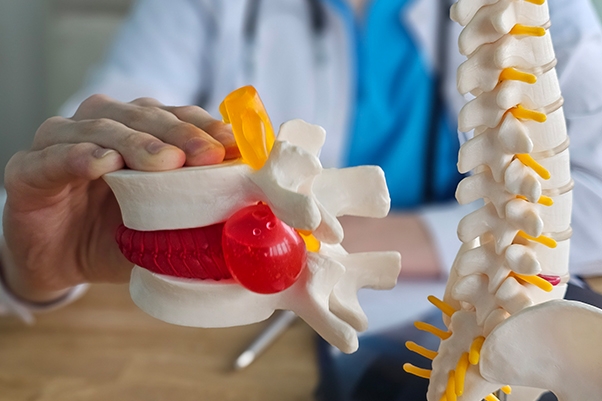
To understand spinal injuries, imagine a jelly donut. Each disc has a tough, fibrous outer layer (the annulus fibrosus) and a soft, jelly-like center (the nucleus pulposus). These discs allow you to bend, twist, and lift without your bones grinding together. However, age, repetitive strain, or sudden trauma can compromise this delicate balance, leading to the two most common disc issues.
How a Bulging Disc Develops and Affects the Spine
A bulging disc occurs when the tough outer layer of the disc weakens and begins to "spill" out of its normal space. Unlike a tear, the outer layer remains intact, but the disc swells outward, often across a large portion of its circumference.
Think of this like a tire losing air pressure; it sags and extends past the rim. While a bulging disc may not cause immediate pain, it can eventually press against spinal nerves, leading to a dull ache or stiffness in the lower back or neck. Because it is often a degenerative condition, early intervention is key to preventing further disc damage, reducing nerve compression, and avoiding chronic back or neck pain.
The Mechanics of a Herniated Disc
A herniated disc, often called a slipped or ruptured disc, is more localized and acute. This happens when a crack or tear forms in the outer layer, allowing the soft "jelly" center to leak out.
Because this internal material contains inflammatory proteins, it can severely irritate nearby nerves. This often results in sharp, electric-shock sensations, numbness, or weakness that travels down the arms or legs. While a bulge is a sagging tire, a herniation is a puncture.
Precision Treatment: The Role of Robotic Spine Surgery
Modern orthopedics has moved far beyond traditional open surgery. For patients requiring intervention, robotic-assisted spine surgery has revolutionized outcomes. Robotic platforms offer 3D mapping and real-time guidance, allowing for unparalleled precision when addressing disc material or stabilizing the spine. By utilizing robotics, surgeons can operate through smaller incisions, which typically results in:
- Reduced damage to surrounding muscle tissue.
- Lower risk of post-operative infection.
- A faster return to daily activities and work.
Finding the Right Path to Recovery
Not every disc issue requires surgery. Many patients find success with physical therapy, anti-inflammatory medications, or targeted injections. However, if your symptoms include significant weakness or loss of bladder control, a surgical consultation is necessary. Identifying the specific type of disc displacement is the first step toward a personalized treatment plan that helps you Feel Better, Move Better, and Be Better.
Frequently Asked Questions About Herniated and Bulging Discs
What is the main difference between a bulging disc and a herniated disc?
A bulging disc occurs when the outer layer of the disc weakens and extends outward but remains intact. A herniated disc happens when there is a tear in the outer layer, allowing the inner material to leak out and potentially irritate nearby nerves.
Which condition is more serious?
A herniated disc is often more symptomatic because the leaked disc material can inflame and compress spinal nerves. However, either condition can become serious if it causes nerve compression, weakness, or loss of function.
What are the most common symptoms of a herniated disc?
Symptoms may include sharp or radiating pain down the arm or leg (such as sciatica), numbness, tingling, or muscle weakness. The location of symptoms depends on which spinal nerve is affected.
Can a bulging or herniated disc heal on its own?
Yes, many disc issues improve with conservative treatment such as physical therapy, rest, anti-inflammatory medications, and targeted injections. The body can sometimes reabsorb herniated disc material over time.
When should I seek immediate medical attention?
Seek urgent care if you experience significant muscle weakness, difficulty walking, loss of bladder or bowel control, or severe, worsening pain. These symptoms may indicate serious nerve compression requiring prompt evaluation.
How is a disc problem diagnosed?
A detailed physical exam combined with imaging studies, such as MRI, is typically used to confirm the diagnosis and determine the extent of nerve involvement.
Will I need surgery for a herniated or bulging disc?
Most patients do not require surgery. Surgical intervention is typically considered only if symptoms persist despite conservative treatment or if there are signs of progressive nerve damage.
What is robotic spine surgery?
Robotic-assisted spine surgery uses advanced imaging and computer-guided technology to enhance surgical precision. It allows surgeons to perform certain procedures through smaller incisions with improved accuracy and potentially faster recovery times.
Hear From Our Patients
Choosing the right orthopedic care is a personal decision, and hearing from others who have been in your position can be helpful. Many of our patients came to us struggling with back or neck pain that limited their work, sleep, and daily activities. Through careful evaluation, personalized treatment plans, and advanced spine care options, they were able to regain mobility and return to an active lifestyle.
To better understand our approach to personalized, patient-centered orthopedic care, explore some of our patient testimonials.
Reference Links:
- Herniated Disk (Slipped or Bulging Disk) - Cleveland Clinic
- Herniated Disk in the Lower Back - OrthoInfo from the American Academy of Orthopaedic Surgeons
AUTHOR: Dhruv Pateder, MD – Spine Surgeon (Neurosurgical & Orthopaedic), Minimally Invasive & Robotic Specialist
Dhruv Pateder, MD is a dual-trained spine surgeon specializing in neurosurgical and orthopaedic spine surgery at Town Center Orthopaedics, with additional locations in Centreville and Reston, Virginia. He provides comprehensive care for spinal conditions ranging from complex scoliosis to minimally invasive, muscle-sparing procedures, disc replacement, and robotic-assisted spine surgery.
Credentials & Recognition
Dr. Pateder completed his orthopaedic surgery residency at Johns Hopkins Hospital, followed by a combined neurosurgery and orthopaedic spine surgery fellowship at Cleveland Clinic.
After fellowship training, he served as an attending spine surgeon at the renowned Steadman-Hawkins Clinic, where he cared for professional athletes and members of the U.S. Ski Team.
Dr. Pateder has conducted extensive research in spine surgery, particularly in the treatment of scoliosis. His work has been presented at national and international meetings and published in numerous peer-reviewed scientific articles and book chapters. He has received multiple awards recognizing both his clinical excellence and research contributions.
In addition, Dr. Pateder has served as an instructor for spine surgeons seeking advanced training in scoliosis correction, minimally invasive decompression, and fusion techniques. He is also involved in the design and advancement of spinal surgical instrumentation.
Clinical Expertise
Dr. Pateder specializes in the full spectrum of spinal surgery, including complex scoliosis correction, minimally invasive decompression and fusion procedures, cervical and lumbar disc replacement, and robotic-assisted spine surgery. His dual training in both neurosurgery and orthopaedic spine surgery allows him to approach spinal conditions with a comprehensive and balanced perspective.
He works closely with orthopaedic specialists within his practice to ensure coordinated care, recognizing that symptoms in the hip, knee, or shoulder can often be linked to spinal pathology. Dr. Pateder prioritizes non-surgical treatments whenever possible, but when surgery is indicated, he utilizes advanced, precision-based techniques to optimize outcomes and recovery.
His philosophy centers on thorough patient education, individualized treatment planning, and helping each patient make informed decisions aligned with their goals and lifestyle.
Medical Disclaimer: This information is for educational purposes only and does not constitute medical advice. For diagnosis and treatment recommendations, please consult with Dr. Pateder or another qualified spine specialist.
Content authored by Dr. Dhruv Pateder and verified against official sources.