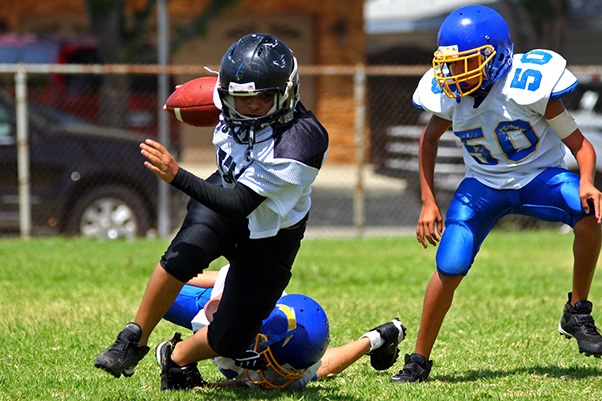
A hard tackle, an awkward landing, or a sudden change of direction can leave a young football player limping off the field. But how can parents tell the difference between a minor sprain and an injury that needs prompt evaluation? Turf toe and foot fractures can sometimes look deceptively mild at first. Learn the warning signs, what these injuries mean, and why early evaluation can help protect your child's recovery and return to play.
Why Football Is So Hard on Young Feet
Football places unique demands on the feet that few other youth sports match. Players push off explosively from a three-point stance, plant and cut suddenly to change direction, and absorb repeated impact from being tackled or falling awkwardly on a foot that is often still bearing significant weight. Add artificial turf into the equation, which tends to grip cleats more aggressively than natural grass, and the foot frequently bears forces it was not quite braced for.
This combination of explosive movement, sudden impact, and high-traction playing surfaces is exactly why foot injuries show up so often in football, and why understanding what is actually happening at the point of injury matters for parents standing on the sideline.
What Turf Toe Actually Is, and Why It's More Than a Bruise
Turf toe is one of the most common yet most misunderstood football foot injuries. It occurs when the big toe is forced upward beyond its normal range of motion, typically when a player pushes off explosively or gets stepped on from behind while the toe is planted. This hyperextension damages the ligaments and joint capsule supporting the base of the big toe.
Despite the name, turf toe is not exclusive to artificial surfaces, though higher-traction turf does increase the risk by keeping the foot anchored longer during the exact motion that causes injury. Symptoms range from mild swelling and stiffness in milder sprains to significant pain, bruising, and difficulty bearing weight in more severe cases. What makes turf toe tricky for parents to assess is that a player may initially walk it off, only to have pain and swelling worsen considerably over the following day or two as the true extent of ligament damage becomes apparent.
Foot Fractures: Recognizing the Signs That Warrant Immediate Attention
Foot fractures in football players typically fall into two categories: acute fractures from a specific traumatic impact, such as a direct hit or an awkward landing, and stress fractures that develop gradually from repetitive impact over the course of a season. Both require a different level of parental vigilance than a simple sprain.
An acute fracture usually announces itself clearly. Significant swelling, visible deformity, inability to bear any weight, and pain that is sharp and localized rather than generalized are all signs that immediate evaluation, rather than a wait-and-see approach, is warranted. Stress fractures are trickier, often beginning as a dull ache that worsens with continued play and improves with rest, a pattern many young athletes and parents initially dismiss as ordinary soreness from a demanding practice schedule. Because sports medicine specialists who treat foot and ankle injuries see this pattern regularly, a persistent ache that does not resolve with a few days of rest deserves a proper evaluation rather than continued play through it.
Why Parents Shouldn't Wait to Have an Injury Evaluated
The instinct to let a young athlete "walk it off" and see how the next practice goes is understandable, especially with turf toe, where the initial injury can look far less serious than it turns out to be. The trouble is that playing through an undiagnosed turf toe sprain or a developing stress fracture can meaningfully worsen the underlying damage, sometimes turning an injury that would have resolved in a couple of weeks into one requiring months of recovery.
A proper evaluation typically includes a physical exam assessing range of motion, stability, and specific pain points, often followed by imaging such as an X-ray to rule out a fracture that might not be obvious from swelling alone. This diagnostic step matters considerably, since turf toe and a foot fracture can present with overlapping symptoms early on, but require very different treatment approaches and timelines.
Getting Back to the Game Safely
Most turf toe injuries and stress fractures respond well to conservative treatment, including rest, activity modification, and supportive taping or bracing to limit the harmful motion while healing occurs. More significant ligament damage or displaced fractures occasionally require a more involved treatment approach, which is why an accurate initial diagnosis matters so much for determining the right recovery path.
Regardless of severity, a gradual, medically guided return to play protects against the all-too-common pattern of a young athlete rushing back too soon, only to reinjure the same foot in a way that sidelines them for the rest of the season.
Frequently Asked Questions
How can I tell if my child has turf toe or just a bruised toe?
Turf toe typically involves pain and swelling at the base of the big toe following a specific pushing-off or hyperextension movement, and symptoms often worsen over the following day rather than improving, which is a key difference from a simple bruise.
Should my child keep playing if their foot pain seems mild?
Mild pain that persists beyond a day or worsens with continued activity should be evaluated rather than played through, since both turf toe and stress fractures can worsen significantly with continued impact.
Does turf really cause more foot injuries than grass in football?
Higher-traction artificial turf can increase the risk of injuries like turf toe by keeping the foot anchored to the ground longer during forceful push-off or hyperextension movements compared to natural grass.
How long does it take to recover from turf toe?
Recovery timelines vary based on severity, ranging from one to two weeks for mild sprains to six weeks or longer for more significant ligament damage, with a gradual, medically supervised return to play recommended in all cases.
When should a foot injury be seen by a doctor instead of monitored at home?
Significant swelling, visible deformity, inability to bear weight, or pain that worsens rather than improves after a day or two of rest are all signs that a foot injury should be evaluated by a specialist promptly.
Foot injuries in young football players are common, but they do not have to derail a season when they are recognized and treated early. If your child is dealing with persistent foot pain after a game or practice, a proper evaluation can help them Move Better, Feel Better, and Be Better, back on the field with confidence, not just back on the field.
AUTHOR: Collin G. Messerly, DPM, FACFAS - Foot and Ankle Surgeon
Collin G. Messerly, DPM, FACFAS is a board-certified, fellowship-trained foot and ankle surgeon at Town Center Orthopaedics in Virginia. His clinical expertise includes sports medicine, trauma, foot and ankle reconstruction, total ankle replacement, lateral ankle conditions, and bunion surgery.
Dr. Messerly earned his medical degree from Des Moines University and completed his surgical residency at Regions Hospital in St. Paul, Minnesota. He then completed an advanced reconstructive foot and ankle fellowship at Shasta Orthopaedics in Redding, California, gaining extensive experience in ankle arthroscopy, total ankle replacement, advanced reconstruction, and minimally invasive surgery.
He treats lower-extremity conditions using both nonoperative and surgical approaches. Dr. Messerly has authored peer-reviewed publications, participated in advanced surgical training courses, and has practiced with Town Center Orthopaedics since 2022.